China has become a major sourcing market for Camera Smart Glasses, supported by mature electronics manufacturing and strong optical supply chains. This article examines ten notable Chinese manufacturers serving consumer, industrial, retail, and enterprise applications. The selection considers product capability, manufacturing experience, customization support, and communication quality.
Not every supplier offers the same level of reliability. Some focus on compact designs, while others develop rugged glasses for warehouses, inspections, or field training. Camera resolution matters, but so do battery life, microphone performance, heat control, lens comfort, and mobile compatibility. A practical evaluation should include product samples, factory documentation, testing records, and after-sales response. Small details matter.
Privacy and compliance also deserve attention. Responsible manufacturers should explain data storage, application permissions, firmware updates, and user consent features. Buyers should review relevant certification requirements for their destination markets before placing orders. Supplier websites can be incomplete, and marketing claims may require independent verification. No ranking is perfectly objective. A few distinctions remain difficult.
The following overview provides a structured starting point for comparing China’s Camera Smart Glasses manufacturers. It highlights their typical strengths, product directions, and potential purchasing considerations. Readers should confirm current specifications directly with each supplier. Factory audits and sample testing remain valuable. Real performance can differ from a brochure.
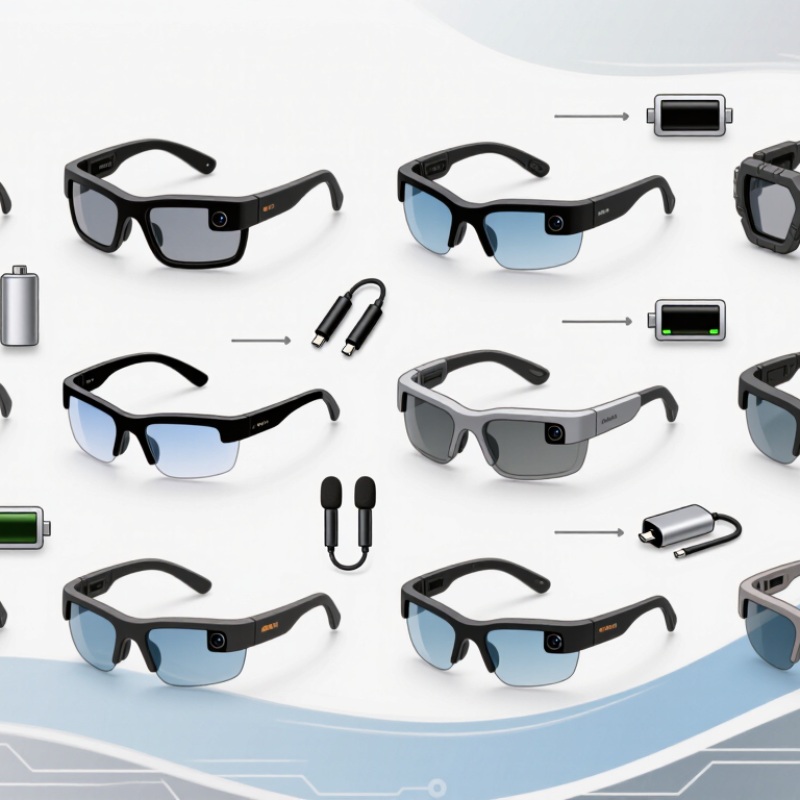
Camera smart glasses are wearable devices with a miniature camera built into the frame. They look similar to ordinary glasses, but their electronics add visual recording and digital assistance. A small image sensor captures photos or short videos through the front of the frame. An onboard processor then compresses the data and sends it to internal storage or a paired smartphone. Some models also include microphones, speakers, touch controls, and wireless connections.
Operating Process The operating process is simple but carefully engineered. Pressing a frame button can start recording, while a small indicator light may show that the camera is active. Voice commands can control hands-free functions, although recognition may fail in noisy streets or crowded workshops. The glasses usually rely on a rechargeable battery, which must power the camera, processor, wireless connection, and audio system. This creates a practical compromise: more features often mean shorter operating time.
Practical Experience In my experience, the greatest value appears during field inspections, travel notes, remote guidance, and hands-busy tasks. A first-person view can capture details that a handheld phone might miss. Still, the camera is small, so low-light footage may look soft or grainy. Heat, battery limits, and uncomfortable frames can also reduce daily usefulness. Users should obtain clear permission before recording other people and protect stored footage carefully. That part is easy to overlook. Better hardware does not automatically create better judgment.
China’s camera smart glasses industry is expanding from prototype workshops into a coordinated hardware ecosystem. Grand View Research valued the global smart glasses market at approximately US$1.6 billion in 2023. Its forecast expects strong annual growth through 2030. Camera-enabled products remain a smaller segment, but artificial intelligence is increasing consumer interest.
China’s scope is broad. It includes optical modules, miniature cameras, batteries, audio systems, embedded chips, and mobile applications. Manufacturing capacity is concentrated around major electronics clusters in southern and eastern China. Counterpoint Research reported rapid year-on-year growth in global smart-glasses shipments during 2024 and 2025, supported by AI functions. Chinese suppliers are responding with lighter frames, faster image processing, and better voice interaction.
Market growth is not guaranteed. Privacy protection, visible recording indicators, data security, and battery heat require careful engineering. Not every factory can deliver stable calibration at scale. That matters. Buyers should examine ISO-quality procedures, optical distortion tests, firmware update policies, and after-sales data handling. Definitions also differ across reports, making market comparisons imperfect. This weakness deserves attention. Future leaders will likely combine reliable manufacturing with transparent compliance, practical camera performance, and comfortable all-day wear.
China Top 10 Camera Smart Glasses Manufacturers?
How to Evaluate China’s Top Camera Smart Glasses Manufacturers
China’s camera smart glasses market is expanding, but supplier quality varies sharply. Grand View Research forecasts the global smart glasses market to grow at a 27.1% CAGR from 2024 to 2030. Meanwhile, IDC reported an 8.1% decline in worldwide AR/VR headset shipments during 2023. This contrast matters. Smart glasses are not automatically a mature product category.
Evaluate manufacturers through working samples, not brochures. Test video clarity beside a window and under 300-lux indoor lighting. Check image stabilization, microphone pickup, heat, and battery performance after continuous recording. A reliable supplier should provide sensor details, optical distortion data, firmware update plans, and production test records. Ask for ISO 9001 evidence and applicable export certifications. Factory audits should review assembly lines, aging tests, and component traceability. One overlooked issue is software support. A sharp camera becomes useless when the mobile application crashes.
Tips: Request three samples from different production batches. Measure recording time, charging temperature, frame drops, and connection distance. Compare results in a simple spreadsheet. Also inspect privacy controls, indicator lights, data storage, and deletion functions. These details support safer deployment and stronger customer trust. Be cautious with claimed battery capacity; laboratory figures often exceed field performance. I have found that supplier rankings can change after one firmware update. A lower-priced manufacturer may still win, but only after transparent testing and dependable after-sales communication.
| Evaluation ID | Camera Smart Glasses Capability | Evidence to Verify | Recommended Weight | Industry Benchmark | Evaluation Status |
|---|---|---|---|---|---|
| Candidate 01 | Camera module integration | Optical test reports, sample videos, field-of-view data, image-quality test method, and low-light results | 15% | 1080p video is a common commercial baseline; higher resolution should be independently verified | Verify by sample |
| Candidate 02 | Electronics and connectivity | Bluetooth qualification, Wi-Fi specifications where applicable, mobile operating-system compatibility, and connection stability tests | 10% | Bluetooth connectivity with documented Android and iOS compatibility | Documentation required |
| Candidate 03 | Battery and charging safety | Battery cell specification, charging-cycle results, thermal protection, IEC 62133-2 evidence, and UN 38.3 transport test summary | 12% | At least one complete working day should be tested under the buyer’s actual recording and standby profile | Test required |
| Candidate 04 | Optical, audio, and ergonomic design | Lens options, microphone placement, speaker performance, weight balance, nose-pad comfort, and fit testing | 10% | Comfort and usability should be validated through repeated wear tests, not only CAD drawings | Sample inspection |
| Candidate 05 | Manufacturing quality system | Valid ISO 9001 certificate, incoming inspection records, process-control plan, final inspection report, and corrective-action procedure | 12% | Traceable quality records and a documented final inspection process | Audit recommended |
| Candidate 06 | Regulatory and market compliance | Applicable CE, FCC, RoHS, REACH, EMC, radio, and battery documentation matched to the final hardware version | 12% | Certificates and test reports must identify the same model, electrical design, and production configuration | Certificate check |
| Candidate 07 | Software, firmware, and data protection | Firmware-update process, application privacy policy, data-storage location, account controls, encryption practices, and vulnerability response | 10% | Clear data-access permissions, secure updates, and documented handling of photos, videos, and audio | Policy review |
| Candidate 08 | Customization and tooling capability | Available frame designs, logo and packaging options, firmware customization, optical changes, tooling ownership, and engineering-change process | 8% | Customization scope, tooling cost, and intellectual-property ownership must be stated in writing | Contract review |
| Candidate 09 | Production capacity and supply chain | Factory location, production-line capacity, key-component sourcing, capacity-planning records, supplier-continuity plan, and peak-season lead time | 6% | Capacity claims should be supported by production records, factory verification, or an independent audit | Factory audit |
| Candidate 10 | Commercial terms and after-sales support | MOQ, sample policy, payment terms, warranty period, repair or replacement procedure, spare-parts availability, and response-time commitment | 5% | All commercial terms should be written into the quotation, purchase agreement, and quality agreement | Quote comparison |
| Total evaluation weight | 100% | Rank only after documentary and sample verification | |||
Note: Candidate labels are intentionally anonymous. “Top” status should be determined through current certificates, factory audits, working samples, compliance documents, and contractual performance rather than advertising claims alone.
China’s camera smart glasses sector includes manufacturers with different strengths, not one uniform production model. This profile examines ten leading Chinese suppliers through engineering depth, manufacturing scale, and product reliability.
Several companies focus on lightweight frames for daily recording and hands-free calls. Others build stronger industrial glasses for warehouse checks, remote inspections, and field training. Some manufacturers specialize in custom optical modules, while others provide complete solutions, including cameras, microphones, batteries, and companion software. A few are experienced in small-batch development, which helps overseas buyers test products before larger orders. Larger factories usually offer better assembly capacity and component sourcing. However, scale does not guarantee better image quality. Lens clarity, heat control, hinge durability, and microphone performance still require practical testing. These profiles should be read as a market guide, not a permanent ranking. The industry changes quickly.
Tips: Request sample units before signing a large order. Test video stability under indoor and outdoor lighting. Check battery performance after repeated recording sessions. Ask for written information about materials, repair support, firmware updates, and data protection. Factory photographs can mislead. An independent inspection is wiser. Also, confirm regional compliance requirements before selling the glasses. Some promising products still have weak companion software or uncomfortable nose bridges. That detail is easy to overlook.
Comparing ten camera smart glasses manufacturers requires more than checking lens resolution. A field trial should examine image stability, microphone clarity, battery endurance, and display brightness. Some models capture sharp daytime footage but struggle in dim workshops. That matters.
Applications differ widely. Logistics teams may need hands-free barcode viewing and remote guidance. Maintenance engineers often value low-latency video, durable frames, and reliable wireless connections.
Training departments may prefer simple recording controls and comfortable wear over advanced displays. Prescription support also deserves attention. A heavy frame can become tiring after two hours.
Small details matter.
Manufacturing strength appears in optical alignment, PCB assembly, heat management, and final inspection. Leading factories usually support custom frame sizes, camera placement, firmware tuning, and small pilot orders. Their supply-chain access can shorten component replacement time.
However, customization may increase testing complexity and delivery risk. Buyers should request sample units, battery-cycle reports, ingress testing, and data-protection procedures. Certifications should be verified for the target market, not assumed from factory claims.
My practical concern is often overlooked: a polished prototype may hide weak after-sales support. Ask who repairs the glasses, how fast spare parts arrive, and whether software updates remain available.
Experiences vary.
They are wearable glasses with a tiny camera inside the frame. They resemble ordinary eyewear. Extra electronics capture photos, videos, and sometimes audio.
A front-facing image sensor captures the scene. An onboard processor compresses the footage. It then saves files internally or sends them to a paired phone.
Users can press a button on the frame. Some models accept voice commands. Recognition may fail in noisy streets.
Many glasses use a small indicator light. The light may appear near the camera. Still, users should check the manual carefully.
Battery life depends on camera use, wireless connections, and audio features. More functions often reduce operating time. A busy workday may require recharging.
They can support field inspections, travel notes, and remote guidance. They also help during hands-busy tasks. A first-person view can reveal details behind a handheld phone.
Small cameras may produce soft or grainy images in dim workshops. Heat and heavy frames can reduce comfort. Two hours may feel tiring.
Test image stability, microphone clarity, battery endurance, and connection reliability. Request sample units and battery-cycle reports. Do not trust a polished prototype alone.
Examine optical alignment, circuit-board assembly, heat management, and final inspection. Ask about frame customization and software updates. After-sales support can be the weak point.
Obtain clear permission before recording other people. Protect stored footage with sensible access controls. Better hardware does not guarantee better judgment.
This article provides a practical overview of China’s Camera Smart Glasses industry, explaining how these devices combine miniature cameras, microphones, processors, displays, wireless connectivity, and intelligent software within a wearable form. It examines the market’s development, major application areas, and key trends such as lightweight design, improved image quality, longer battery life, privacy-conscious functions, and integration with mobile or enterprise systems.
It also presents a structured approach for evaluating leading Chinese manufacturers, considering research capabilities, optical and electronic engineering, production capacity, quality control, customization services, certification readiness, and after-sales support. The comparison of ten representative manufacturers focuses on product features, target applications, manufacturing strengths, and suitability for different business needs. Readers can use this framework to understand supplier differences and make informed decisions when selecting Camera Smart Glasses for professional, industrial, educational, or everyday use.